PAPER TOYS, PAPER ART, AND ORIGINAL DESIGN OBJECTS MADE IN CHILE FOR CREATIVES AND FUTURE GENIUSES.


Kaleido: The Fascinating Intersection of Escher's Art and Mathematical Strategy
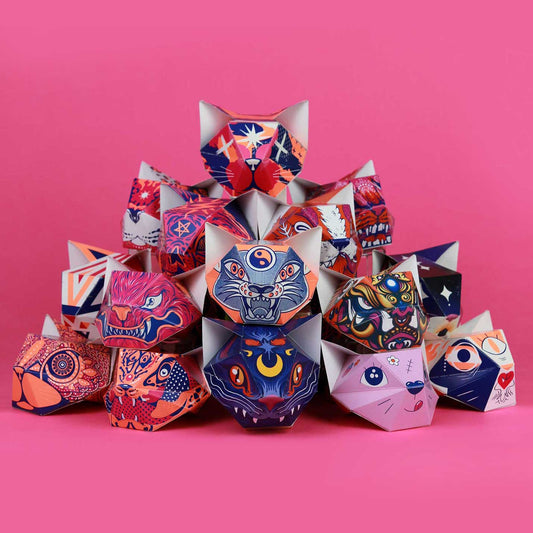
Is it a design object, a geometric sculpture, or a board game? The answer is: all of the above. At Proyecto Ensamble, we have brought Kaleido to life—a kaleidocycle inspired by the geometric figures that fascinated artist M.C. Escher, with an innovative twist: a mathematical game system integrated into its very structure.
What Is a Kaleidocycle?
A kaleidocycle is a ring of tetrahedra that can rotate continuously around itself through an inversion movement. It is a piece of paper engineering that challenges spatial perception. In Kaleido, however, this movement is not merely aesthetic; it is the engine of the gameplay.
How Do You Play Kaleido? The Cycle of Addition and Subtraction
Unlike traditional puzzles, Kaleido is a game of numerical strategy. The graphic design of each piece is intentional: it contains the elements needed for a mental duel. Here are the official rules:
- Start: Choose any face of the kaleidocycle and one of its 6 triangles. Make sure it is not a subtraction.
- Addition: Add the numbers in the chosen triangle. The result tells you how many times you must rotate the kaleidocycle inward.
- Signs (+) and (-):
- (+) Plus: Find the larger number + the color of its circle.
- (-) Minus: Find the smaller number + the color of the entire triangle.
- Subtractions: If an extra circle surrounds the larger number, it is a subtraction. Subtract the smaller number from the larger number to determine how many turns to make. Subtractions are only played when you land on them, not at the beginning.
- Objective: Complete a sequence of additions and subtractions determined at the start (for example, 2 additions and 1 subtraction). The first player to complete the sequence wins!
Chilean Engineering for Future Geniuses
Kaleido is a product developed, edited, produced, and distributed by Proyecto Ensamble in Chile. It is designed for creatives and geniuses aged 7 to 99. It is also a perfect tool for STEM (Science, Technology, Engineering, and Mathematics) learning through touch and visual thinking.
Watch the Tutorial in Action
Want to see how the inversion movement works and how the rules are applied in real time? Watch our quick video tutorial here:
Kaleido is a non-toxic product. All rights reserved © 2025 Proyecto Ensamble. Visit us at proyectoensamble.com to learn more about our brand and modular design.